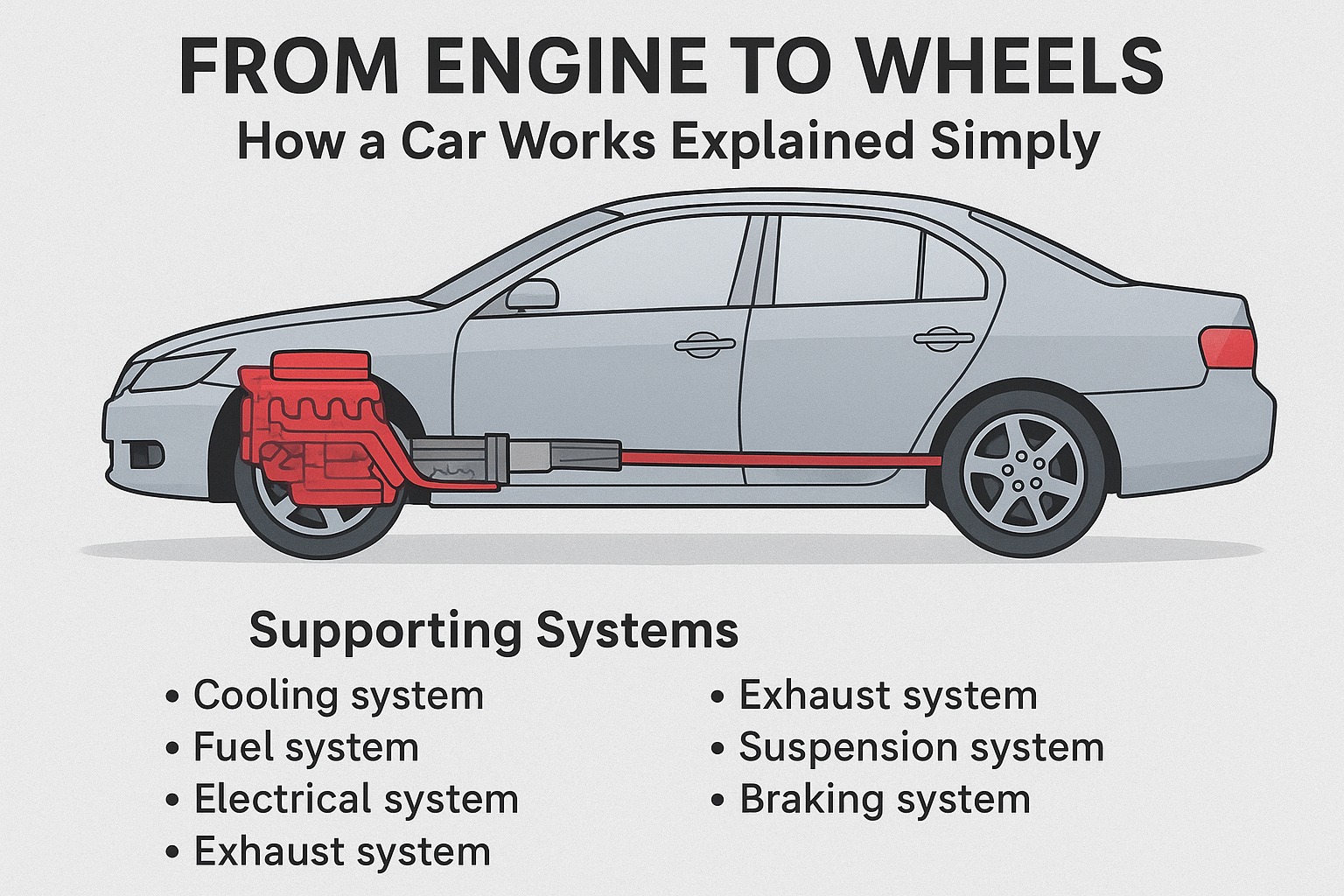
From Engine to Wheels: A Detailed Look at How Cars Operate
Cars are part of our everyday lives, but many people never think about how a vehicle truly works from engine to wheels. The moment you hit the start button, a complex system of mechanical and electrical components jumps into action, all working together to move the car smoothly. Understanding how a car functions from engine to wheels not only satisfies curiosity but also helps drivers appreciate the technology they rely on and take better care of their vehicles.
In this guide, we’ll simplify the entire process step by step, showing exactly how power travels from the engine to the wheels in a clear, engaging, and easy-to-understand way.
1. The Engine: The Heart of Every Car
The engine is the powerhouse responsible for generating the energy needed to move the vehicle. Most cars use internal combustion engines, which convert fuel into motion through controlled explosions.
How It Works:
- The engine pulls in air and mixes it with fuel.
- This mixture enters the combustion chamber.
- The spark plug ignites the mixture, causing a small explosion.
- The explosion pushes pistons down, creating power.
- That power is transferred to the crankshaft, creating rotation.
This cyclical process happens thousands of times per minute, giving your car the strength it needs to move.
2. From Engine to Wheels: The Role of the Transmission System
Once the engine creates power, the transmission decides how much of that power reaches the wheels. You can think of it as the mediator that ensures you get the right amount of speed without overworking the engine.
Why It’s Important:
- It changes gears to suit your speed.
- It keeps the engine running smoothly.
- It transfers power efficiently to the driveshaft.
Automatic transmissions do this on their own, while manual ones require the driver to shift gears.
3.The Driveshaft Explained: How Power Moves From Engine to Wheels
After power leaves the transmission, it travels through the driveshaft—a long spinning tube that carries force to the axles.
How the system works:
- The driveshaft spins at high speed.
- It transfers power to the differential.
- The differential adjusts power based on wheel speed.
- This power finally reaches the axles and wheels.
The differential is especially important when turning, because the inner and outer wheels need to rotate at different speeds.
4. The Wheels: Where Power Becomes Motion
The wheels are the final step in the process. They convert the mechanical power from the axles into forward motion.
How wheels create movement:
- The power from the axles rotates the wheels.
- Tires grip the road and push backwards.
- The car moves forward because of friction and momentum.
The quality of your tires affects handling, stopping distance, fuel efficiency, and ride comfort.
5. Steering System: Guiding the Direction
While the engine powers the car forward, the steering system helps you control your direction smoothly.
Key Components:
- Steering wheel
- Steering rack
- Tie rods
- Power steering pump or electric motor
When you turn the wheel, the steering mechanism translates that movement into the turning motion of the front wheels.
6. Braking System: Bringing the Car to a Safe Stop
One of the most important systems in any vehicle is the braking system. Modern cars use disc brakes, which are reliable and provide strong stopping power.
From Engine to Wheels: How Brakes Work to Stop Your Car Safely:
- Pressing the brake pedal increases hydraulic pressure.
- Brake fluid pushes calipers onto the brake discs.
- The friction slows down the wheels.
- The car comes to a controlled stop.
Anti-lock Braking System (ABS) prevents wheel lockup and maintains control even during sudden braking.
7. Electrical System: The Brain Behind the Machine
Cars today rely on a powerful electrical network that manages everything from ignition to infotainment.
What’s included:
- Battery
- Alternator
- Sensors
- ECU (Engine Control Unit)
- Lights and electronics
The ECU acts like the car’s brain, constantly monitoring performance and making real-time adjustments.
8.From Engine to Wheels: How Exhaust and Emission Systems Work
Every time fuel burns in the engine, it produces gases. The exhaust system safely removes these gases and reduces pollution.
Main Functions:
- Routes exhaust through the catalytic converter
- Reduces harmful emissions
- Lowers engine noise
- Improves fuel efficiency
A well-functioning exhaust system keeps the car running smoothly and helps protect the environment.
9.From Engine to Wheels: How the Cooling System Keeps the Engine at the Right Temperature
Engines produce a lot of heat. Without cooling, they would overheat and fail quickly.
Cooling System Includes:
- Radiator
- Coolant
- Water pump
- Thermostat
This system circulates coolant around the engine to maintain an optimal temperature, ensuring long-term engine health.
10. Suspension System: Comfort and Stability
The suspension system absorbs bumps and keeps your car stable, providing a smooth and safe ride.
How It Works:
- Shock absorbers reduce vibrations
- Springs absorb road impact
- Control arms maintain wheel alignment
Good suspension ensures better handling, braking, and comfort.
Conclusion
A car may look simple from the outside, but underneath the body is a complex network of systems working together like a well-rehearsed team. From the engine creating power to the wheels putting that power on the road, every component plays a vital role in making your drive smooth, safe, and efficient.
Understanding how cars operate not only increases your appreciation for the machine but also helps you become a more informed and confident driver. Whether you’re a car enthusiast or someone simply curious about how your vehicle works, this deep dive from engine to wheels gives a clear look at the remarkable technology behind every drive.